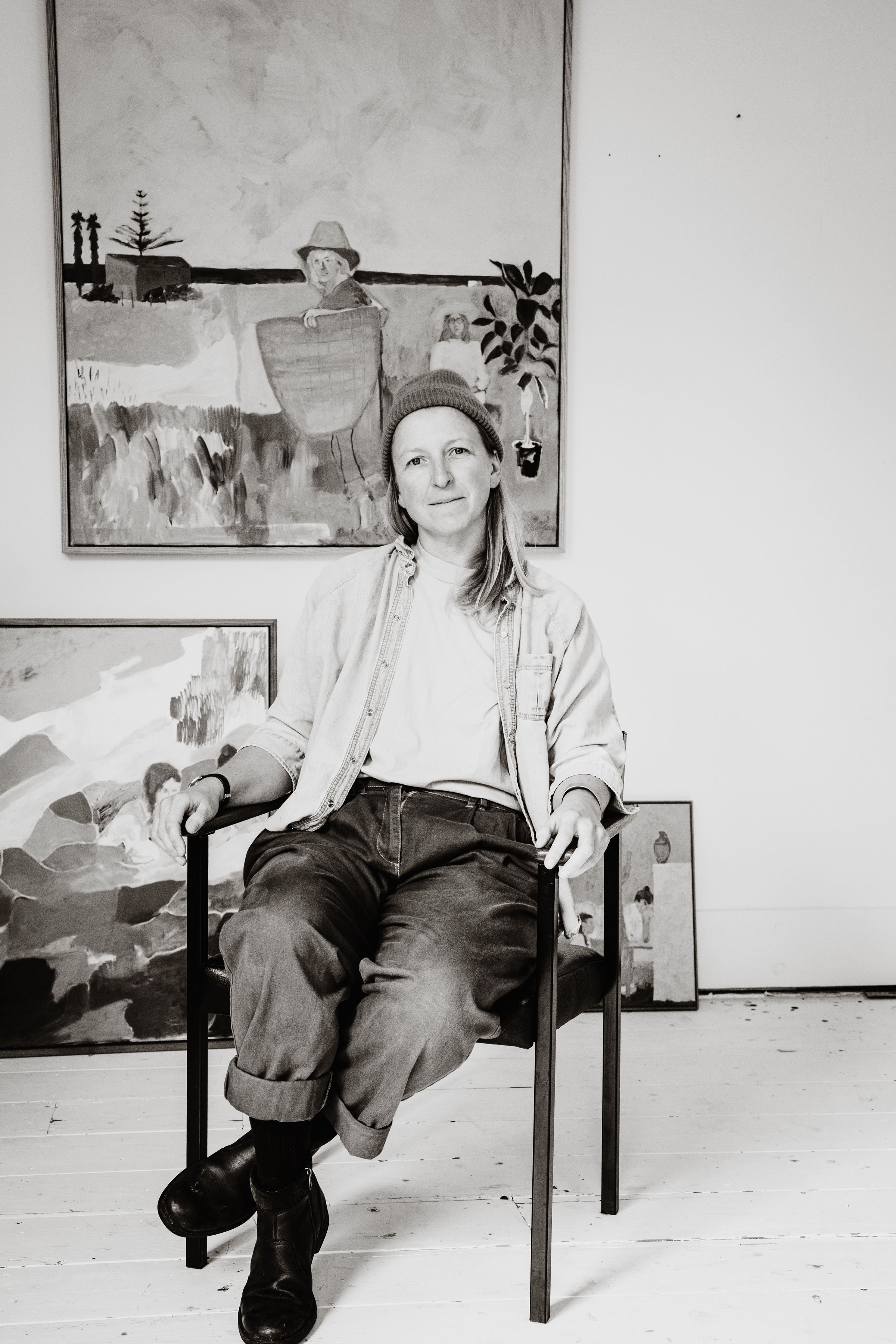
Exploring Etching with Emily Kirby

In Conversation

Born in Mazabuka, Zambia, Emily Kirby is a figurative painter living in Hove, Sussex UK.  For over 15 years, Kirby has built a practice rooted in painting, exploring narrative, texture, and the subtleties of mark-making.


Recently, she expanded her process through an intensive etching course at The Royal Drawing School in London, discovering new ways to revisit past work and extend ideas beyond the canvas. In this interview, Kirby reflects on the discoveries of working with copper plates, and how etching has opened up new ways to engage with her imagery.


View Available Work by Emily Kirby

March 18, 2026
  • OTOMYS: You recently attended an etching course at the Royal Drawing School in London. What made this the right moment in your practice to undertake that experience?
     
    EMILY KIRBY: I had been looking onto courses at the Royal Drawing school for a few years, it has a really good reputation, I'm a big fan of a number of artists that have studied there. Having completed another broader printing course a while back, I wanted to spend  a more intensive period of time at a printing studio that provides all of the etching equipment including acid baths. So I was really happy when this course, specifically in etching, came up. It was such a rich experience, spending long hours learning the different processes and working out which methods worked best for my practice. The tutor Maggie Jennings was really engaging and knowledgeable so I feel I learnt a lot.
  • OTOMYS: Your practice has been centred on painting for many years. What prompted you to explore a new process at this stage, and how did you begin thinking differently about your source material going into the course?
     
    EMILY KIRBY: I've been almost entirely focused on painting for 15 years and was starting to feel I needed something to compliment and further push my process and explore ideas. I often look at sketches I've made which have led to paintings and thought there was something in them that I'd like to take further, but felt the sketches themselves needed to remain in  the sketchbook. However, once an idea has turned into a painting, there are sections within the paintings that I've often want to revisit. While I was thinking about the source material to use before starting the course, I realised this was the perfect opportunity to use these sections and continue working with them.  It's allowed me to spend more time with past works and reflect further on narratives within the paintings.
  • OTOMYS: Your copper plate etchings carry a distinct atmosphere. How did the physical and technical conditions of etching, its sensitivity, constraints, and risks, shape the way you approached image-making?
     
    EMILY KIRBY: After seeing examples of the possible effects you can achieve  through the different etching techniques, I realised the most painterly and slightly harder to control method, something I'm always attracted to, is etching in acid using a soft ground. I loved using  a copper plate. the sensitivity of the soft ground on copper allows you to make very subtle marks as you sketch an image out. I found that, for me, redrawing the image out again by free hand and playing with different marks, the print remains fresh and far more successful than tracing over a prepared image. Although there's no room for going back on a mark once it's made, the high risk element is also part of the joy. I've had some plates I've had to abandon because of one or two small marks in the wrong place, especially around the face.  It's so frustrating when it happens, but it also makes the successful plates feel even more special.
  • OTOMYS: Working across different printmaking techniques, what was it about the temporality and repeatability of etching that ultimately resonated with your way of working?
     
    EMILY KIRBY: I think I had originally thought Mono Printing would be a better fit for me. But I realised  I love the longer process of etching and the possibility of  making small editions from a plate. Each time you ink up and take it through the press, each one has its own subtle uniqueness, again you can spend more time with it. I've definitely enjoyed seeing the paintings alongside the etchings, their contrast allows for an opportunity to look differently between the works,  it gives them space.
     
  • More From Emily Kirby